vrushangshah93@gmail.com
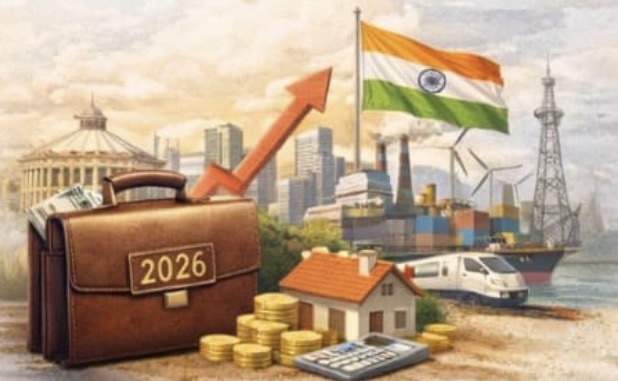
 Budget for the financial year April 2026 to March 2027 has presented by Finance Minister Nirmala Sitharaman. The focus this year was on providing incentives for manufacturing, especially in the MSME space. There was clear acknowledgement of the need for creating job opportunities.
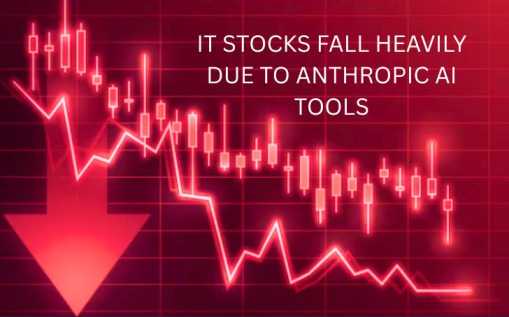
The Indian stock market has not liked this Budget, and it damped heavily. Sensex down for 1546.84 points which wiped out Investors money. Nifty has also cracked down by 495.20 points which shows the Indian stock market has given a red flag to Budget 2026.
STT (Securities Transaction Tax) has been increased and that impacted heavily and Stock market has not liked this move and all the Capital Market shares have reacted in negative especially BSE, Angel One, CDSL and NSDL.
We start with the Positives of this Budget:
- Economic growth targeted at 7& plus with moderate inflation which is a positive sign.
- Capex has been increased on roads, railways, ports and power.
- Continued incentives for domestic high tech manufacturing.
- Robust funding for the agricultural sector & food security.
- Promoting Youth employment, skilling and job creation.
- MSME support through credit schemes & simplified access to government tenders.
- Focus on sustainable energy and green initiatives.
- Support for women-centric welfare schemes and senior citizens.
Negative Points:
- No major changes in tax rates. In the last budget, taxpayers received a huge benefit but, in this Budget, there’s no changes in individual tax returns.
- No changes in Long term capital gain tax. Long term capital gain means if you have purchased a share and hold that shares for more than one year then at time of selling then this gain is treated as Long term capital gain. But there’s no changes in LTCG.
- No changes in Short term capital gain tax. Short term capital gain means if you have purchased a share and hold that shares for less than one year then at time of selling then this gain is treated as Short term capital gain. But there’s no changes in STCG.
- STT has increased which caused a lot to future option traders.
Key Updates:
1. Infrastructure Spend
Government to spend ₹12.2 lakh crore in FY27 to improve roads, bridges, and create jobs.
2. Railways
7 new High-Speed Rail Corridors to connect major cities and boost business.
3. Tech & Semiconductors
India Semiconductor Mission 2.0 with ₹40,000 crore to make India a global chip hub.
4. Industry Support
‘Shakti’ Initiative with ₹10,000 crore to strengthen semiconductor manufacturing.
5. Freight & Logistics
New Freight Corridor from Dankuni (East) to Surat (West) for faster cargo delivery.
6. Support for MSMEs
₹10,000 crore SME Growth Fund + ₹2,000 crore more to Self-Reliant India Fund.
7. Textiles & Rural Development
Schemes to modernise textiles & rural sectors, including mega textile parks and Mahatma Gandhi Gram Swaraj initiative.
Scaling up manufacturing-
Bio Pharma Shakti: Outlay of 10,000 crores for next 5 years to create ecosystem for Bio Pharma infrastructure for critical disease.
India semi-conductor mission– launch ISM 2.0 to create full stack IP.
Rare-earth: support to mineral rich states of Odisha, Kerala, AP to promote manufacturing and research. Planning to have rare-earth magnet corridors.
Outlay of 40,000 crores for electronic component manufacturing.
Container manufacturing– allocation of 10,000 crores for 5 years period.
Textile– national fibre scheme, Technological development, national handloom program. To set up a Mega textile plant- value addition to technical textile.
Rejuvenation to support legacy industries: 10,000 crores growth fund for SME and 2000 crores for Micro Enterprise.
Infrastructure:
Allocation of 12.2 lakh crores for cape, (Cement, Steel, Paint)- in line with expectations (9-10% growth). Propose to set up an infrastructure credit fund.
Cargo– Establish a new DFC connecting Dankuni in the East to Surat in the West. Operationalized 20 new waterways.
Railways– 7 high speed rail corridors between cities as growth connectors.
Ship Repair infra– to set up in Varanasi and Patna.
Financials:
Will set a high level committee for the banking and financial sector. Restructure reforms for PFC and REC.
Residents outside India can invest in equity with a Portfolio investment plan.
Set up 3 All India institutes for Ayurveda.
Creation of 5 university townships in major industrial and logistic corridors.
Veterinary loan linked subsidy to support for Veterinary colleges. (Hester Bio and Hikal).
Fiscal Consolidation:
Target debt to GDP 50% (+1/-1%) by FY31. Debt-to GDP at 55.6% in FY27. Fiscal deficit at 4.4% in FY26. Fiscal Deficit for FY27 at 4.3%.
FY27 net tax receipts at 28.75 lakh crores. FY27 net borrowing at 11.7 lakh crores. FY27 expenditure at 53.5 lakh crores.
So overall this Budget has beneficial for MSME, IT industry, energy sector and for the students who wants to study abroad. Disappointment for the traders of future option as STT has been increased and no relief in LTCG and STCG and no relief in individual Income tax return.
About the Author